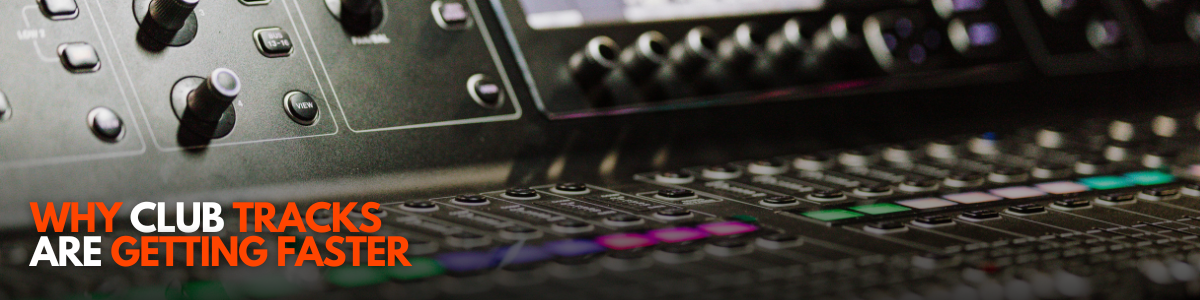
In 2018 the median techno track sat at 128 BPM. By 2025 it was 140. That is not a feeling from a sweaty dancefloor, it is the year-by-year median across tens of thousands of techno tracks catalogued by the DJ tool Mixgraph. Hard techno moved further still: from around 140 BPM in 2020 to 155 in 2025.
Anyone who has been to a club in the last few years already knew this. The warm-up starts where the peak used to be, and the peak goes somewhere that would have been called gabber a decade ago. The interesting questions are what is actually speeding up, why, and whether it lasts.
What is actually getting faster
Not everything. This is the part most hot takes miss.
Using the same Mixgraph data, the picture splits cleanly:
- Techno: 130 BPM in 2019, 140 in 2025.
- Hard techno: 140 in 2020, 155 in 2025.
- Hardstyle: 150 in 2018, 160 in 2025.
- UK garage: 132 through 2022, 136 by 2024.
- House and tech house: up about 3 to 4 BPM (house 124 to 128, tech house 125 to 129).
- Trance, drum and bass, afro house, amapiano: essentially flat. Trance held at 138, D&B at 174, afro house at 122, amapiano at 113.
So the acceleration is concentrated in techno and the hard end of dance music. House nudged up. The revival genres of the moment, trance and D&B, got more popular without getting any faster.
The wider industry data points the same way. The IMS Business Report 2026 described SoundCloud's 2025 sound as "harder and faster", noted that the share of hardcore and hardtekk tracks above 180 BPM has grown every year for three years, and recorded schranz uploads up 83%. On TikTok, #SpeedGarage grew 147% year on year.
Reason one: a new generation walked into the club at full speed
The most repeated explanation is the pandemic. Clubs shut for the best part of two years, and when they reopened, a large share of the crowd had never been clubbing before.
Quail, who runs Animal Farm in Glasgow, told Mixmag in 2023: "It's the youngest I've ever seen people in the clubs... the average age used to be like 23, 24 and now it's between 18 and 21." And the new crowd did not want to be eased in. "People were just wanting it fast from the beginning. People don't know what a warm-up is anymore." His own party, NEED 4 SPEED, runs a no-warm-up policy.
Worth noting: Quail says he first noticed tempos creeping up in the second half of 2019. Covid did not start the shift. It poured fuel on it.
Charlotte de Witte made the same link in a 2025 DJ Mag cover interview: "So many new artists popped up after Covid, and hard techno really became a thing."
Reason two: the internet sped up first
Before club tracks got faster, pop did, just not in the studio. In 2023 the four most popular songs on TikTok in the US were all sped-up versions, led by Justine Skye's "Collide", according to Billboard. Labels now routinely release official sped-up edits alongside originals. Apple Music's Scott Plagenhoef told Billboard that sped-up songs "mirror the pace at which users consume content online."
Nobody has proven that sped-up pop directly pushed club tempos up, and it would be dishonest to claim it. But a generation whose ears were calibrated by 1.25x playback and nightcore edits arriving in clubs expecting intensity is at least a plausible fit. DJ mixtress put it bluntly to Mixmag: "TikTok's got something to do with it... a little bit of it is down to Gen Z's attention span."
The same goes for streamed sets. Hard, fast sets from HÖR Berlin pulled millions of views during and after lockdown, and the clips that travel furthest online are the ones with the most impact per second.
Reason three: the scene started describing itself by tempo
When a genre gets defined by a number, the number becomes the target. Man Power told Mixmag about switching agents and being told "all they were being asked for was DJs who play at 140 BPM... It was a shock to me that people were describing the music by its tempo rather than what it was."
Once 140 is the entry ticket, the bar moves. DJ Impulsive Behaviour described it happening in real time: in 2020 hard techno "was still like 140 BPM to 145 BPM max", and by 2021 "145 was the minimum, and people were playing up to 160."
The crowd pushes too. When a fan in Paris asked VTSS to go "faster and harder" in 2021, her reply was: "Paris techno folk scare me, I literally started at 145 bpm."
And the fast end went mainstream. Sara Landry became the first techno artist to headline Tomorrowland's main stage, played Coachella 2025 and entered DJ Mag's Top 100. Beatport, which had folded hard techno into its Peak Time category in early 2020, reinstated it as a standalone genre with its own chart that August after labels pushed back.
Reason four: hard times, hard music
There is an older pattern here too. Mixmag's 2023 investigation drew a line between today's cost-of-living crisis and the early 90s, when recession-era Britain produced hardcore and records like The Prodigy's "Experience". Faster, harder dance music has a habit of showing up when life outside the club gets tougher. It is not a law, but the rhyme is hard to ignore.
Is it slowing down?
Possibly, and the signal is coming from inside the scene.
In the same 2025 DJ Mag interview, Charlotte de Witte said: "I feel now the hard techno thing, in my opinion, is coming to an end. It's not what everyone is raving about." She added that "techno has become the new EDM... It can be very commercial", and described digging back into 2013-era records for a slower, groovier, stripped-down sound.
The numbers are consistent with a plateau. In Mixgraph's data, techno peaked at 140 BPM in 2025 and sits at 138 so far in 2026, though a part-year sample is too small to call a turn.
Meanwhile the fastest-growing sounds are not fast at all. Afro house climbed from 24th to 4th in Beatport's most-searched styles, and was Beatport's 7th most-downloaded genre in 2025, all at a steady 122 BPM. Amapiano sits around 113. Dance music is not simply getting faster. It is stretching at both ends.
What this means if you make or play music
- Tempo is a choice, not a trend to chase. A track that is fast only because the charts are fast will date the moment the charts move. The records that last are right at their own tempo.
- Know the room you are building for. A 150 BPM hard techno night and a 122 BPM afro house terrace are both packed in 2026. Write for one of them on purpose.
- Warm-ups still matter. "People don't know what a warm-up is anymore" was a complaint, not a manual. A good opener who can hold a room at a lower tempo is harder to find than ever, which makes it valuable.
- Watch the flat genres. The genres that grew without speeding up (trance, D&B, afro house) show that energy is not the same thing as BPM. As Indira Paganotto once said of psytrance, "you can listen at 150 bpms but it's still super peaceful."
The speed-up is real, it is measurable, and it has reasons behind it. Whether 2025 was the peak, the dancefloor will decide. It always does.

 Events