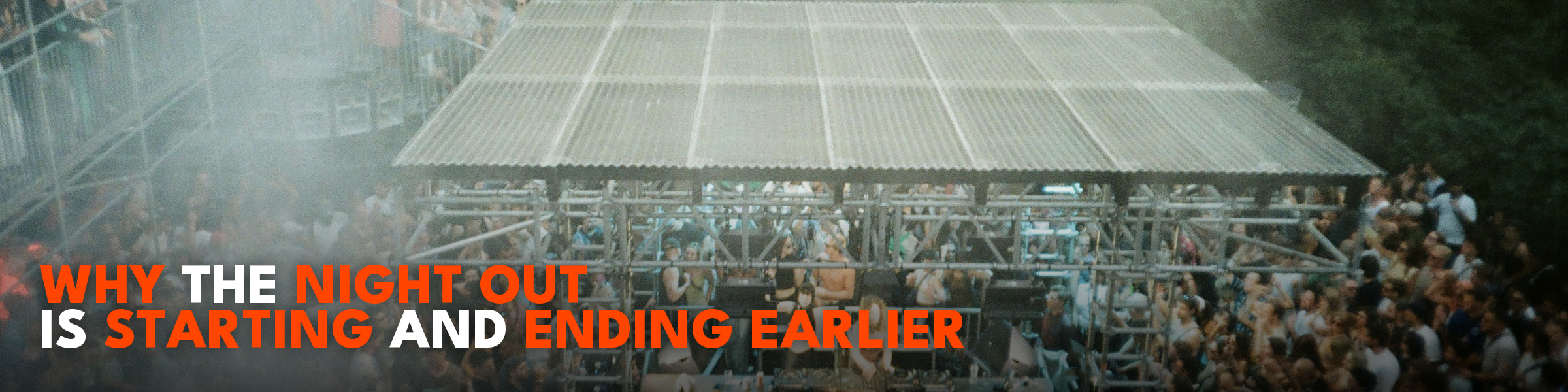
Ten years ago, the biggest nights James Brown ran for One Drop in Brixton started at 10pm. Today, he told Eventbrite, "our most popular events start around 4pm and wrap up by around 10pm." Plenty of promoters in London and beyond tell a similar story. The crowd still wants to dance. It just wants to be home before the night buses take over.
At the same time, the late-night side of the business keeps shrinking. In September 2026, data from the Night Time Industries Association (NTIA) and NielsenIQ showed that nearly 29% of Britain's late-night economy has disappeared since March 2020, and nightclubs have fallen by 36% over the same period. The same NielsenIQ data shows a falling share of sales in the late evening and night, as people go out and come home earlier. Early parties and closing clubs are usually covered as two separate stories, but they are closely linked.
The Numbers Behind A Shrinking Night
The latest monitor contains a small piece of good news. According to the Press Association report carried by LBC, late-night venues (bars, nightclubs and casinos that open late) grew by 0.4% between March and June 2026, net of closures. That was the first growth since March 2025. Even so, there were still 3.1% fewer venues than a year earlier. Since pre-Covid, bars are the only major sub-sector to have grown, up 3.1%, while clubs have lost more than a third of their number.
The longer view is tough reading. In early 2025 the NTIA reported that nightclubs had fallen from 1,240 in March 2020 to 835 by November 2024. Independent clubs were hit harder than the average, down 36.1%. Wales and Yorkshire each lost more than 40% of their clubs. In 2024 the trade body launched its Last Night Out campaign, which Resident Advisor reported with a stark warning from NTIA chief Michael Kill: "Without urgent intervention, December 31, 2029, will be the last night out."
In October 2026 the pressure moved to tax. According to London Loves Business, the night-time economy suffered a net loss of more than 14 venues a week in the first six months of 2026. Eligible pubs and live music venues in England will get an extra 15% off business rates in 2026-27, but dedicated nightclubs do not qualify. On the publication's illustrative figure, the relief would be worth £6,000 a year to a club with a £40,000 rates bill. "When a nightclub disappears, we don't just lose a dancefloor," Kill said.
Daylight Is The New Peak Time
Daytime parties are growing. In a release from its UK newsroom, Eventbrite said that attendance at daytime music, club and party events had risen 44% over the previous year. It also named 4pm to 10pm as the new peak hours. This is the ticketing company's own platform data rather than an industry-wide count, but promoters describe the same pattern.
Danny Soyle, who runs What's the Motive UK, said many of their events run from 4pm to 10pm and that "these are really popular with 21-28-year-olds." Samuel Bonsu, who organises Reconnect: Coffee Club in Croydon, puts the start even earlier: "the sweet spot is late morning into mid-afternoon." Long-running venues are adapting too. Carwash in London has added a 10am Saturday Cardio Dance Party and Sunset Sessions, a daytime disco. Its director of disco, Nikki Bell, said Gen Z "has forced the biggest recalibration of what matters most."
Eventbrite's interviewees give practical reasons for the earlier hours:
- Getting home safely without relying on late-night transport
- More sleep, and feeling better the next day
- The sober-curious movement, which has taken parties into coffee shops, yoga studios and brunch clubs
This is not the same as the warehouse all-nighter moving to a Sunday afternoon. Many of these events are smaller and more social, and they are built around a shorter window. For a sound system and a DJ, though, a dancefloor is still a dancefloor.
Fewer Nights Out, Bigger Nights Out
The electronic music economy is not shrinking, which complicates the picture. The IMS Electronic Music Business Report 2025/26, presented by MIDiA Research's Mark Mulligan at IMS Ibiza in April 2026, valued the global electronic music industry at $15.1 billion in 2025, up 7% on the year before. According to coverage in Menorca.info, the report found that club ticket revenue in Ibiza reached €160 million in 2025, even though fewer events were held.
The report's explanation is that audiences go out less often but spend more on each night. Demand is moving towards large productions, exclusive offers and VIP areas. Mulligan described a dancefloor that is "more selective", where the overall experience carries decisive weight. The report also warned that higher ticket prices and fewer events could make it harder for younger audiences to get in. IMS ran its 2026 edition under the slogan "Reclaim the Dancefloor".
Taken together with the UK data, the trend is clear. The weekly, open-ended, late-finishing club night is under the most strain. The one-off big event and the shorter, earlier party are both holding up.
Berlin: Busy Rooms, Thin Margins
Berlin shows that full dancefloors do not guarantee a working business model. The Clubkultur Berlin 2026 study, presented on 7 August 2026 by Clubcommission Berlin and the city's economics department, surveyed more than 100 clubs in March and April. As Pollstar reported, ticket sales now make up 59% of club revenue, up from 21% in 2017. Food and drink, which brought in 60% of revenue in 2017, now accounts for a much smaller share.
Other findings from the study:
- Only 61% of operators could cover their operating costs in 2025, down from 79% in 2017
- 60% say their audiences have less money to spend, and 85% say economic pressure has changed their programming
- 67% have raised drink prices and 47% have adjusted ticket prices
- At least 24 club and cultural venues have closed since 2020 and about 25 have opened
- Only 8% own their venues, and 23% have considered closing within the next 12 months
The study's summary is useful for any city: "Berlin's club culture is not dying; it is under pressure to transform." The revenue figures suggest a crowd that buys a ticket but spends less at the bar, which fits the sober-curious habits behind the day-party boom. Clubs that relied on late-night bar takings are losing that income.
What It Means For People Who Play And Promote
For DJs, the timetable is changing. A 4pm start used to mean the warm-up. At a growing number of events it is now the main part of the night, and the closing set may finish around 10pm. Reading a room that is only partly dark, holding energy across a six-hour window and programming for a crowd that may not be drinking all require different skills from the 3am peak slot, and those skills are worth practising.
For promoters, the Berlin and Ibiza numbers point the same way: the door now matters more than the bar. Ticket pricing, capacity and how often to run a night have become the main decisions, and a monthly event that feels special may now outperform a weekly one. In the UK, bars are the only late-night category that has grown since 2020, so bar-sized rooms are likely to provide more bookings for newer selectors than struggling mid-sized clubs.
None of this means the late night is finished. Berlin's clubs are busy, Ibiza's ticket revenue is rising and UK late-night venue numbers have just grown for the first time in more than a year. The night out is changing in three ways: it starts earlier, it happens less often, and people expect more from each one. Whether it can also stay affordable for the people who built club culture is something the figures cannot yet answer.
Cover photo by Tanya Prodaan on Unsplash

 Feature