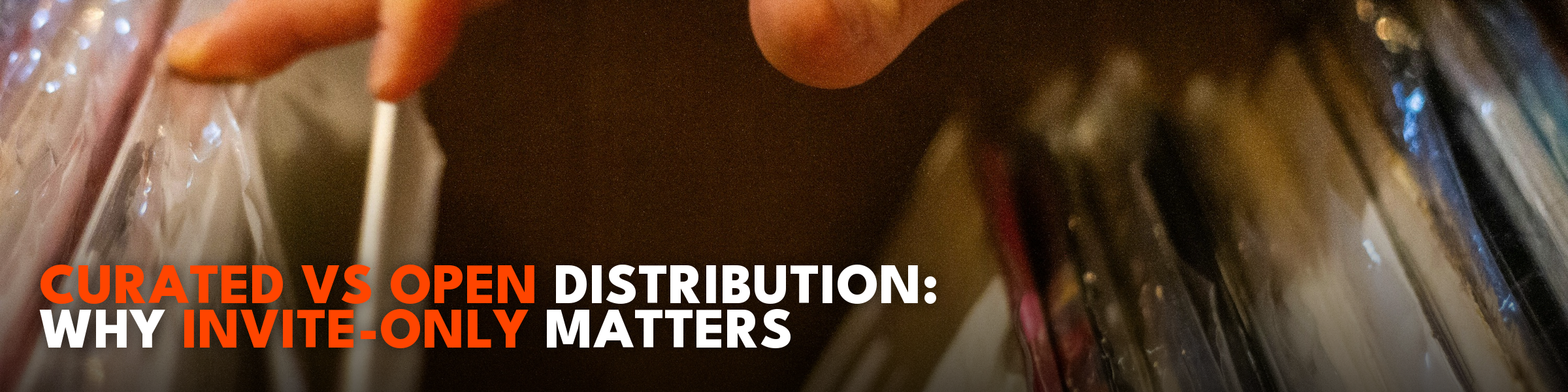
Most artists never think about this choice because most distributors never make it visible. You sign up, you pay, you upload. That is open distribution, and it is the default. A smaller number of platforms work the other way: they decide who gets in. That is curation, and the difference is bigger than it sounds. It changes the company your release keeps, the credibility of the catalogue you sit in, and whether an actual person ever looks at your music.
Here is what each model really means and how to tell which one fits how seriously you take this.
What "open" distribution actually means
An open distributor accepts anyone who can pay the fee or agree to the terms. There is no gate. That has an obvious upside, anyone can release, and a less obvious cost: you are one upload in a catalogue of tens of millions, next to every bedroom experiment, every reupload, and a great deal of outright spam.
For years that did not seem to matter. It matters now. When a catalogue is infinite and unfiltered, the platforms downstream stop trusting it, and they build filters to deal with it that every release in that catalogue has to pass. Open access was sold as democratic. In practice it buried serious artists in noise they had no part in making.
What curation changes
A curated distributor reviews who it works with before letting them in. You apply, and you are accepted or you are not. That single gate changes three things.
- The catalogue means something. A roster that someone vouched for is a smaller, more credible place to sit than an open ocean. Being on it is a signal, not just a transaction.
- Real people are involved. Curation only works if humans actually listen. That usually means you are dealing with people who know your genre, not a ticket queue, and that the feedback and support you get are real.
- You get attention that does not scale on open platforms. An open distributor cannot give millions of users individual care. A selective one, by design, works with few enough artists to give each one some.
The trade is honest and worth stating plainly: you have to be accepted. Curation is not for everyone, and it is not meant to be.
The Spotify cleanup made this concrete
This stopped being theoretical in 2025. In September 2025 Spotify said it had removed over 75 million spammy tracks in the previous 12 months, and announced a music spam filter aimed at tactics like mass uploads, duplicates, SEO hacks and artificially short tracks. We wrote about what that means for emerging artists here: Spotify Just Deleted 75 Million Tracks.
The lesson underneath it is simple. The open, unfiltered flood is exactly what the platforms are now cleaning up, and serious artists who share a catalogue with the spam are the ones who have to stay clear of it. Sitting in a curated, human-reviewed roster is not a vanity preference any more. It is a way to keep your release on the credible side of a line the platforms are actively drawing.
Who curated distribution is not for
To be fair about it: if you release rarely, treat music as a hobby, and just want the simplest possible path to getting a track on Spotify, an open platform is fine and you should use one. There is no shame in it. Curation asks you to apply and to wait, and it exists for artists who want the catalogue they are in to mean something. If that is not you, do not fight it.
What to check before applying to a curated distributor
Selective is not automatically good. A gate is only worth passing through if what is behind it is real. Before you apply, check:
- What the acceptance actually gets you. Curation should come with services and people, not just a smaller list. Publishing administration, access to sync briefs, and real support from people who know your genre are the point. A velvet rope with nothing behind it is just marketing.
- That you keep your rights. Selective or open, you should keep ownership of your masters and your compositions. Read the term and the exit.
- That the people know your genre. Curation by people who do not understand your music is worse than no curation. For electronic artists that means the humans involved should actually work in electronic music.
- How you get in, and how long it takes. A clear application and a defined answer beats a vague "we will be in touch" with no timeline.
Where ANGVIS Music Distribution fits
ANGVIS Music Distribution is curated on purpose. It operates exclusively through invite: you submit a short application, and if you are accepted you receive an invite code within 48 hours. Every application is reviewed by a person, and that is deliberate.
We built it that way because independent electronic artists were being treated as an afterthought inside open catalogues that had stopped meaning anything. Accepted artists sit in a curated roster and get worldwide delivery to the major stores and streaming platforms, Beatport and Traxsource included, publishing administration, and access to sync briefs they can pitch their own tracks to, all run by a team that works in electronic music. You keep ownership of your masters and your compositions. Quality and the fact that a person listened matter more to us than headcount.
You have to be accepted, which is the whole point. If you take your music seriously and want to be somewhere selective, you can apply here: distribution.angvis.com/apply.
The short version
Open distribution takes anyone and buries you in an infinite, increasingly distrusted catalogue. Curated distribution decides who gets in, which makes the catalogue credible and puts real people between you and the stores. The platforms are now actively filtering the open flood, so where you sit matters more than it used to. Curation is not for hobbyists, and that is fine. If you want the roster you are in to mean something, choose selective, and check that there is something real behind the gate before you apply.
FAQ
What is a curated music distributor?
A curated distributor reviews and approves who it works with, rather than accepting anyone who pays. You apply and are accepted or declined. The result is a smaller, more credible catalogue and, usually, real people who know your genre involved in your releases.
What is the difference between open and curated distribution?
An open distributor accepts everyone, so your release sits in a catalogue of tens of millions including a large amount of spam. A curated one is selective, which keeps the catalogue credible and means humans actually look at your music. The trade is that you have to be accepted rather than just sign up.
Is invite-only distribution better?
It is better for artists who want the catalogue they are in to mean something and who value real support from people who know their genre over the largest possible platform. It is not better for occasional hobbyists who just want the simplest path to a release. Judge it on what the acceptance actually gets you.
How do I get into a curated distributor like ANGVIS Music Distribution?
ANGVIS Music Distribution is invite-only. You submit a short application at distribution.angvis.com/apply, and if accepted you receive an invite code within 48 hours. It is open to independent electronic artists who treat their music as a career.
Does being in a curated catalogue help with the Spotify spam filters?
It can help indirectly. Spotify's spam filter targets tactics like mass uploads, duplicates and SEO hacks, which are most common in open catalogues. Sitting in a smaller, human-reviewed roster with clean metadata keeps your release on the credible side of those filters, though no distributor can promise how any platform treats a specific track.
Cover photo by Cord Allman on Unsplash

 Events